Practical guide
The train gets you to the station. It rarely gets you to the door.
Between the platform and where you are actually going — a home, a hotel, an office, an airport — there is almost always one last leg. It is the part that takes the most organising, and the part people plan for least.
My VTC Go provides private transfers from stations across Lorraine, Luxembourg and the border region. Whether you arrive by TER, TGV, CFL or from Germany, your driver meets you at the station and takes you directly to your final destination.
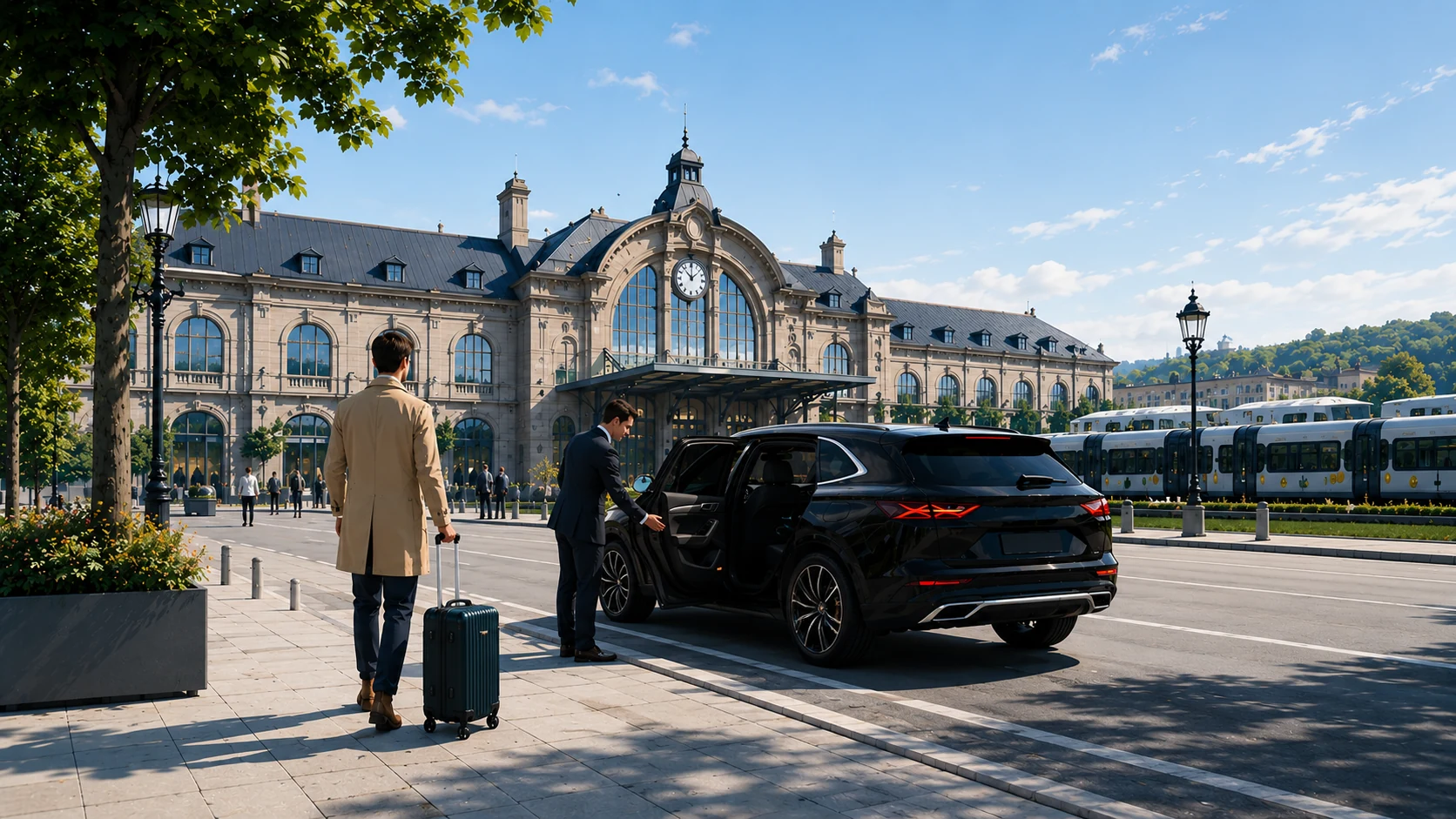
The rail network across the Greater Region is dense. It connects Metz, Thionville, Nancy, Luxembourg and the major European cities efficiently. But it stops at stations — and your destination is not always one of them.
A business park, a hotel on the outskirts, an industrial site, a home in a village with no rail service: in each case, the train alone will not do.
Booking a driver in advance means the last leg is settled before you even arrive. You step off the train, your driver is there, you go.
In practice, a transfer earns its place when you are travelling with luggage or professional equipment, when you arrive with children, when your train gets in early in the morning or late at night — precisely when onward connections thin out — when your destination sits outside the city centre, or when you are heading straight into a meeting.
In none of these cases is comfort the real issue. Logistics is.
Luxembourg's central station is where the Grand Duchy's rail network converges. Trains from France, Belgium and Germany all terminate here.
Since March 2025, the T1 tram line has run directly from the station to Kirchberg, Cloche d'Or and Findel airport. For those destinations, the tram does the job, and there is no sense pretending otherwise.
A chauffeur earns its place elsewhere: business parks the tram does not reach, outlying communes, journeys with luggage, the hours when public transport thins out, and onward travel into France or Belgium. From Luxembourg station, we run transfers to Esch-sur-Alzette, Belval, Mondorf-les-Bains and across the border region.
Thionville is the principal rail gateway for cross-border commuters. The Metz–Thionville–Luxembourg line is one of the busiest in France: tens of thousands of journeys a day, with up to three regional trains an hour at peak times.
That density has a downside. Between 6am and 8am, and again between 4pm and 7pm, trains run full. And when the Luxembourg network undergoes engineering work — a recurring feature of recent years — trains are replaced by buses, and journey times double.
A chauffeur does not replace the daily commute: nobody books a private car every morning to get to work. But it becomes the answer when the train no longer serves — a fixed appointment, a journey with luggage, a destination with no station, or a period when the line is closed.
From Thionville we serve Cattenom, Yutz, Manom, Hayange, Hettange-Grande and the wider northern Moselle.
Metz-Ville is the main station of the Moselle network: TGV services to Paris, regional TER trains, and a direct link to Luxembourg in roughly 45 minutes to an hour.
It is a city-centre station, which is both its strength and its limit. Reaching the centre is immediate. Reaching the outskirts is another matter: the Technopôle, Woippy and the business districts to the north are not within walking distance.
Heading on to Amnéville for the spa, a concert at the Galaxie or an evening at the casino? Our Amnéville transfer service covers the whole site.
Many travellers only discover on arrival that Lorraine TGV station is in neither Metz nor Nancy.
It sits in open countryside, in the commune of Louvigny, some thirty kilometres from each city. It was designed to serve both — which, in practice, means being close to neither.
It handles the TGV services that bypass Paris altogether: Bordeaux, Nantes, Rennes, Lille, Brussels, Strasbourg. Shuttle buses connect it to Metz (30 minutes) and Nancy (35 minutes), and CFL runs a coach link to Luxembourg.
Those shuttles work, and the fare is often included in the TGV ticket. But they are collective services: fixed timetables, no door-to-door pickup, and limited flexibility if your train runs late or you are travelling heavy.
Hettange-Grande is not a major station — it is a halt on the Metz–Thionville–Luxembourg line, just short of the border.
Its value is strategic rather than architectural: it is the last French stop before the Grand Duchy, served by the regional TER trains that run between Thionville and Luxembourg.
From Hettange-Grande we run transfers to the surrounding villages, Thionville, Cattenom and across the border region.
Not every station takes every kind of train. The distinction looks technical, but it is what determines which station you should be aiming for.
| Train | What it serves |
|---|---|
| TER Grand Est | Regional services: Metz, Thionville, Nancy, Longwy, Hayange, and the cross-border line to Luxembourg. The everyday train, and the commuter's train. |
| TGV INOUI | High-speed national services: Paris, Strasbourg, Lille, Bordeaux, Nantes, Rennes, Brussels. Calls at Metz-Ville, Thionville and Lorraine TGV. |
| CFL | The Luxembourg network, linking the capital to the border towns and the rest of the Grand Duchy. |
| RE / RB | German regional trains, serving Trier, Saarbrücken and the Moselle valley. Your connection into Germany. |
This is why a station like Metz-Ville or Thionville, served by both high-speed and regional trains, plays a different role from a halt like Hettange-Grande, where only regional services stop.
Three things matter, and proximity is not among them.
The trains that stop there. A high-speed station opens up the national network. A regional halt connects you locally. Depending on whether you are coming from Paris or from Metz, the right station is not the same.
Where it sits. Metz-Ville is ideally placed for the city, far less so for a business park on its edge. Lorraine TGV, by contrast, is near nothing but serves the whole of France.
What connects at the other end. Luxembourg station has the tram. Lorraine TGV depends on fixed-timetable shuttles. Hettange-Grande has neither.
It is the combination of these three — not distance — that decides which station suits your journey.
Arriving by train but unsure which station makes most sense? Depending on where you are ultimately headed, some allow a more direct transfer than others.
| Your destination | Recommended station | Journey time* | Why |
|---|---|---|---|
| Kirchberg | Luxembourg | 10–20 min | Direct T1 tram, or a car if you are carrying luggage |
| Cloche d'Or | Luxembourg | 10–20 min | Direct T1 tram from the central station |
| Findel Airport | Luxembourg | 15–25 min | Direct T1 tram, or a car for an early flight |
| Esch-sur-Alzette / Belval | Luxembourg | 20–30 min | Frequent onward connections |
| Cattenom | Thionville or Hettange-Grande | 10–20 min | Both stations serve the area |
| Yutz, Manom | Thionville | 5–15 min | Neighbouring communes |
| Amnéville | Metz-Ville or Hagondange | 20–30 min | Depending on your train and your timing |
| Metz Technopôle | Metz-Ville | 10–20 min | The closest station to the site |
| Metz-Nancy Airport | Lorraine TGV | 10–15 min | The station lies 7 km from the terminal |
| Pont-à-Mousson, Nancy | Lorraine TGV or Nancy-Ville | 30–45 min | Depending on which train you are on |
*Indicative ranges, calculated outside peak hours and based on road distances. On the A31, or approaching Luxembourg at rush hour, allow more. Your pickup time is set with those conditions in mind.
If your journey does not match any of these, simply give us your arrival station and your destination when you book.
The area is threaded with smaller stations. They make more sense grouped by rail corridor than taken one by one.
Hayange · Uckange · Hagondange
These stations serve the industrial basin of the Fensch valley. The urban fabric here is dense but drawn out: towns string along the valley floor, and any one station covers only part of the area it nominally serves. That is precisely what makes the last mile awkward.
From these stations we run transfers to neighbouring towns, business parks and local employers.
Audun-le-Roman · Longuyon · Longwy
This line runs north towards the Belgian and Luxembourg borders. Longwy is a gateway to the southern Grand Duchy — Esch-sur-Alzette, Belval, Pétange — and into Belgium.
It is border country, with real daily flows, but a markedly thinner rail service than the Metz–Thionville–Luxembourg axis. Private transfers here tend to answer what the train does not: awkward hours, destinations away from the tracks, direct cross-border runs.
Metz · Pont-à-Mousson · Nancy
The historic north–south spine of Lorraine, and the best-served corridor in the region — which does not remove the need for transfers: destinations away from the city centres remain hard to reach by public transport.
Bettembourg · Perl · Luxembourg
Bettembourg is the rail junction of southern Luxembourg, and where trains from France pass through. Perl, on the German side, opens onto the Moselle valley and the Saarland.
These stations share one trait: they are pivot points between two networks, two countries, sometimes two fare systems. That is exactly where connections get complicated — and where a direct transfer earns its keep.
Three arrangements, depending on how the station is laid out:
In every case you are notified by text message or phone call, and a WhatsApp location share lets you see exactly where your driver is. You will not be scanning the crowd.
30 minutes of waiting time are included, counted from your train's scheduled arrival. Beyond that, each additional 15-minute period is charged at €15.
That window covers the ordinary delays of the network. For a serious delay, let your driver know: arrangements can be adjusted.
By way of comparison, the included waiting time is 60 minutes for airport transfers, since baggage reclaim takes longer.
The vehicle takes three suitcases, or four smaller bags. For anything bulkier, tell us when you book.
Available on request, arranged before the journey (€10 supplement). Give us the child's age so the right seat is fitted.
Welcome, with a €10 supplement. Please mention it when booking.
Journeys into Luxembourg, Germany and Belgium are routine. It is what we do most days.
Five minutes of preparation heads off most of the complications.
Transfers start at €20. The fare depends on distance, pickup point and destination. Your price is confirmed before you book: no meter, no surcharge along the way.
30 minutes of waiting time are included, counted from your train's scheduled arrival. Beyond that, each additional 15-minute period is charged at €15.
Yes. Cross-border journeys are routine from Luxembourg Central Station. Pickup can be arranged anywhere, provided the booking is made in advance.
Yes, including transfers to Metz, Nancy, Thionville, Pont-à-Mousson and Metz-Nancy-Lorraine airport, which lies 7 km away.
Booking ahead is not compulsory, but it is advisable — it guarantees a vehicle is available at your time. For an early-morning train, book ahead.
Yes. Recurring journeys are available, particularly for cross-border commuters and regular business travel.
You are notified by text message or phone call, and you can follow your driver's position via WhatsApp. A name-board greeting is available on request (€10 supplement).
Yes, all coach stations across the Moselle and Luxembourg, including Metz, Thionville and Luxembourg.
Give us your arrival station, your destination and the time of your train.